

Intel 12th-Gen Core Alder Lake Architectural Benchmark
A few months back we investigated CPU cadre misconceptions, explaining how overall processor performance is affected not only by how many cores a CPU has, merely other factors including cache levels and capacity. This was an interesting and unique look at Intel'due south tenth-gen series in an article we titled "How CPU Cores & Cache Impact Gaming Operation." Basically what we did was compare the Core i9-10900K, Cadre i7-10700K and Core i5-10600K at the same iv.ii GHz frequency, with the same retention, memory timings, ring bus frequency, and then on.
Then compared the 3 CPUs with only 6 cores / 12 threads enabled to run into how much of a deviation the L3 enshroud capacity made when it came to gaming functioning. Later on that, nosotros compared that data to the 10700K and 10900K with 8 cores enabled, and finally the 10900K with all of its 10 cores turned on.

Long story short, information technology turns out that in almost all games, it's not the core count but the L3 cache capacity that is responsible for the improved performance seen across the college-stop Intel parts. Of course, down the track the extra cores will see those college-finish parts pull even further ahead, merely at least on today's games it's all virtually the L3 cache.
That investigation afterwards morphed to a quad-cadre version where we included Core i3 models and a similar accept for AMD CPUs, where we looked at 10 years of AMD CPU progress and back to Intel for the aforementioned.
To wrap up that content, nosotros thought we should add the new Intel Alder Lake 12th-gen CPUs to the data puddle, and so hither nosotros are, and it's been a more involved procedure than we outset imagined. Whereas all other CPU architectures had one, two, or maybe three dissimilar configurations, 12th-gen Cadre has three per CPU.

For example, the 10th-gen CPUs had a 20MB L3 cache with the Cadre i9 model, 16MB for i7 and 12MB for the i5 models, Alder Lake's cache capacity is segmented in a like fashion, 20MB of L3 for the Core i5, 25MB for i7 and 30 MB for i9. But and then on top of that nosotros had to work out what kind of cadre configuration we should test. Iv P-cores, Four Due east-cores or a mixture of both? The right answer was of class all three configurations and that'south provided the states with a wealth of juicy information to get over.
To be clear, with four P-cores enabled we were using Hyper-Threading, then this is a four-core/viii-thread configuration. Basically SMT was enabled when supported for all test configurations. This means because the E-cores don't support SMT the four E-core configuration was 4 cores with iv threads. And then the mixed configuration which featured ii P-cores with 2 E-cores was a 4-core/half dozen-thread configuration.

For testing we've used the MSI Z690 Tomahawk Wi-Fi DDR4 as we wanted to use the same DDR4-3200 CL14 low-latency retentiveness that was used to test all the other CPU architectures that back up DDR4. In our testing, DDR5-6000 has not shown to exist whatever faster for gaming, but most importantly we wanted to keep the data as apples to apples equally possible for this feature. Finally, all configurations were tested using the Radeon RX 6900 XT. Let's dive into the data.
Benchmarks
Starting with Rainbow 6 Siege, in that location'southward quite a bit to go over, so bear with me. First let's just expect at the Core i9-12900K, we run across with iv P-cores enabled and locked at 4.two GHz that this configuration was good for 510 fps, merely 3% faster than AMD's Zen three architecture.
Then with 2 P-cores and two E-cores enabled, performance dropped by 15% which is a fairly meaning reduction, and then with but four East-cores enabled performance drops by a further 12% which isn't that much and non nearly the reject I was expecting. Quite shockingly, in this championship 4 E-cores were able to lucifer the performance of the Cadre i9-11900K, though the 11th-gen architecture does suck in this championship, but still I didn't expect to see whatsoever results like this.
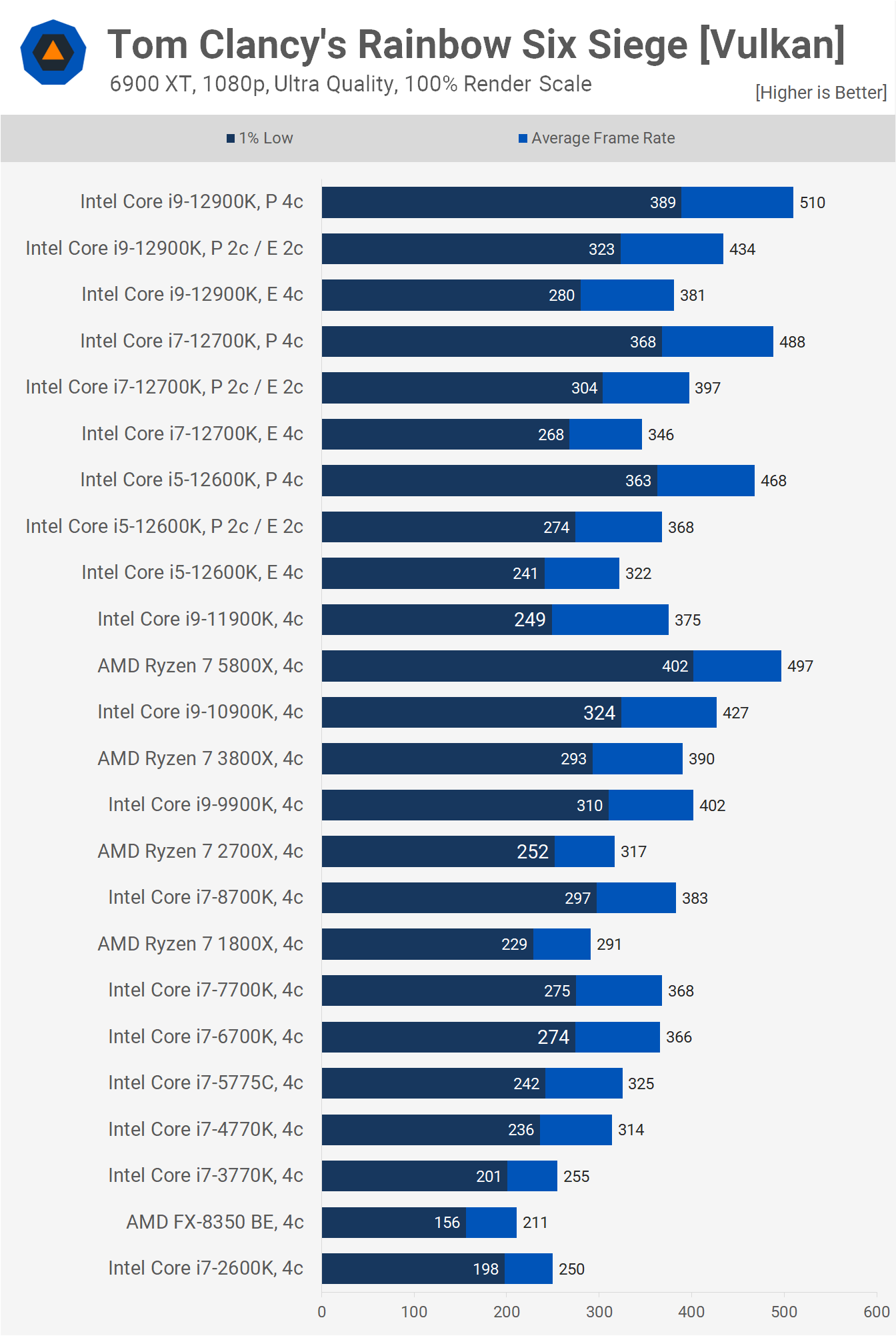
When comparing the diverse twelfth-gen processors, nosotros see that from the 12600K to the 12700K the additional L3 cache boosts performance by four% with merely the P-cores enabled, or seven% with merely the E-cores. And then from the 12700K to the 12900K we're looking at a farther 5% operation heave for the P-cores and a rather substantial 10% heave for the Due east-cores.
If we compare all the information we have we see that the 12th-gen CPUs with just their E-cores enabled are comparable to Skylake equally Intel claimed, at least when looking at the 12900K data. It'south also interesting to note that with ii P-cores and two E-cores the 12900K was quite a bit slower than four Zen 3 cores. And then this suggests that a part like the 5950X will terminate up being much faster than the 12900K for gaming, once games heavily utilise 16-cores... in similar 10 years from now.
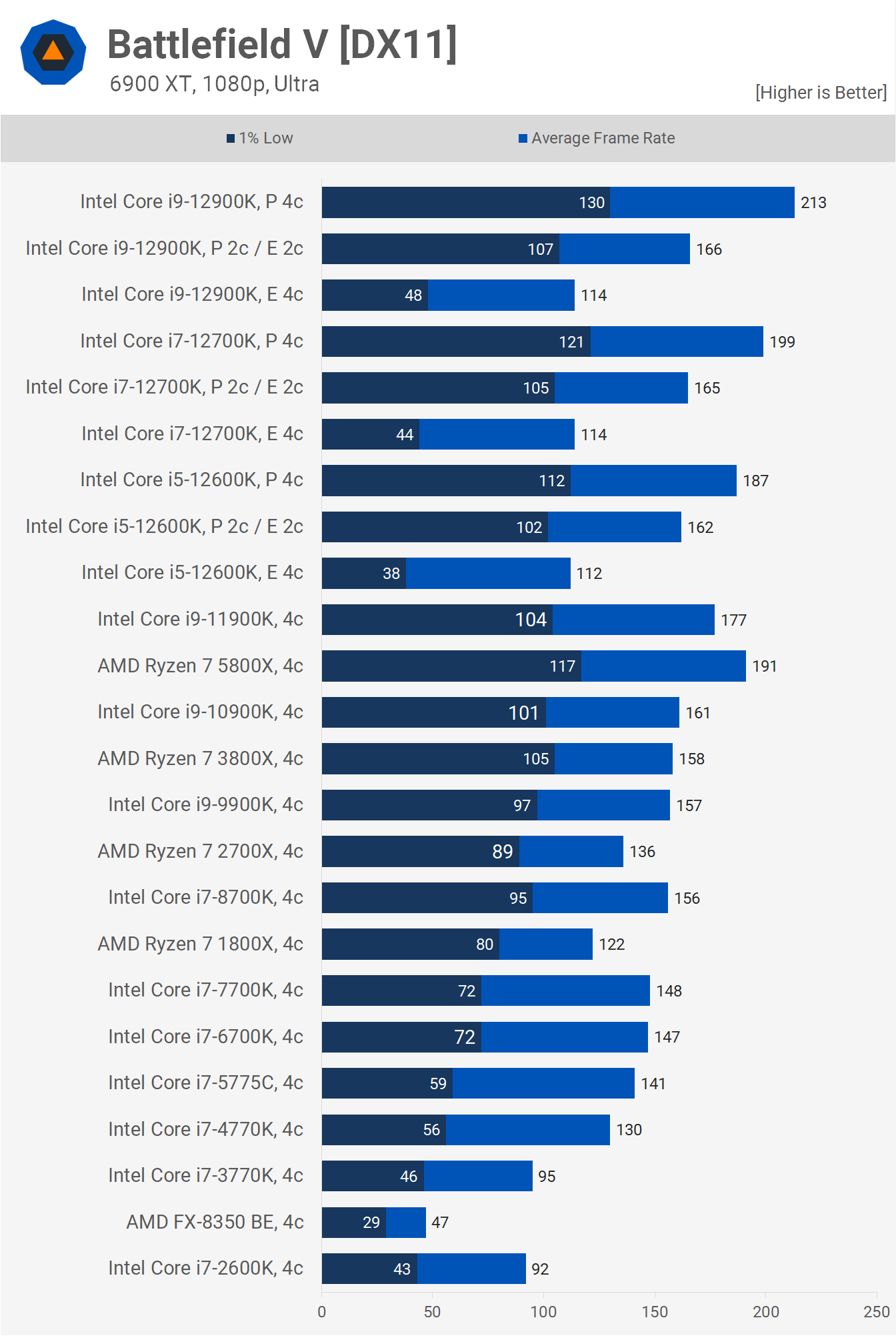
Moving onto Battlefield V results, we gain a few interesting insights. Beginning, is that the Eastward-cores suck big time in this title, non only is the average frame charge per unit almost halved when compared to what we see when just using the P-cores, merely the 1% low performance is shattered.
We're looking at a 22% reduction in performance with the 12900K when going from 4 P-cores to 2 P-cores and 2 E-cores. Then we see a further 31% reduction when moving to E-cores exclusively. Worse, that means the P-cores were 87% faster when looking at the average frame rate and 170% faster when looking at the 1% low. So those efficient cores are devastatingly dull in this game, and anything but efficient.
Nosotros likewise run into that when the E-cores are enabled, the larger L3 cache capacity of the i7 and i9 models doesn't upshot in any actress functioning, or at to the lowest degree very little in the fashion of extra performance. All the same with but the P-cores the 12700K was 6% faster than the 12600K and and so the 12900K was 7% faster than the 12700K.
If we compare that information with the residuum of the CPU architectures we've tested, there'due south a few noteworthy comparisons to be made. When compared to Zen 3, Alder Lake is up to 12% faster, seen when comparing the 12900K with the 5800X. That said, the smaller 20MB cache of the 12600K meant it was ii% slower while the 25MB i7 was just iv% faster. And then information technology'due south that larger 30 MB L3 cache that gets the Cadre i9 firmly over the line.
That said, if we were to force Intel to utilise the E-cores for gaming, nosotros see that the mixed 2 P-cores/2 E-cores configurations fall behind Zen 3. Then if you were to use E-cores exclusively, operation falls off a cliff and now we're talking nowhere near Skylake levels of gaming performance, think more Sandy Span.
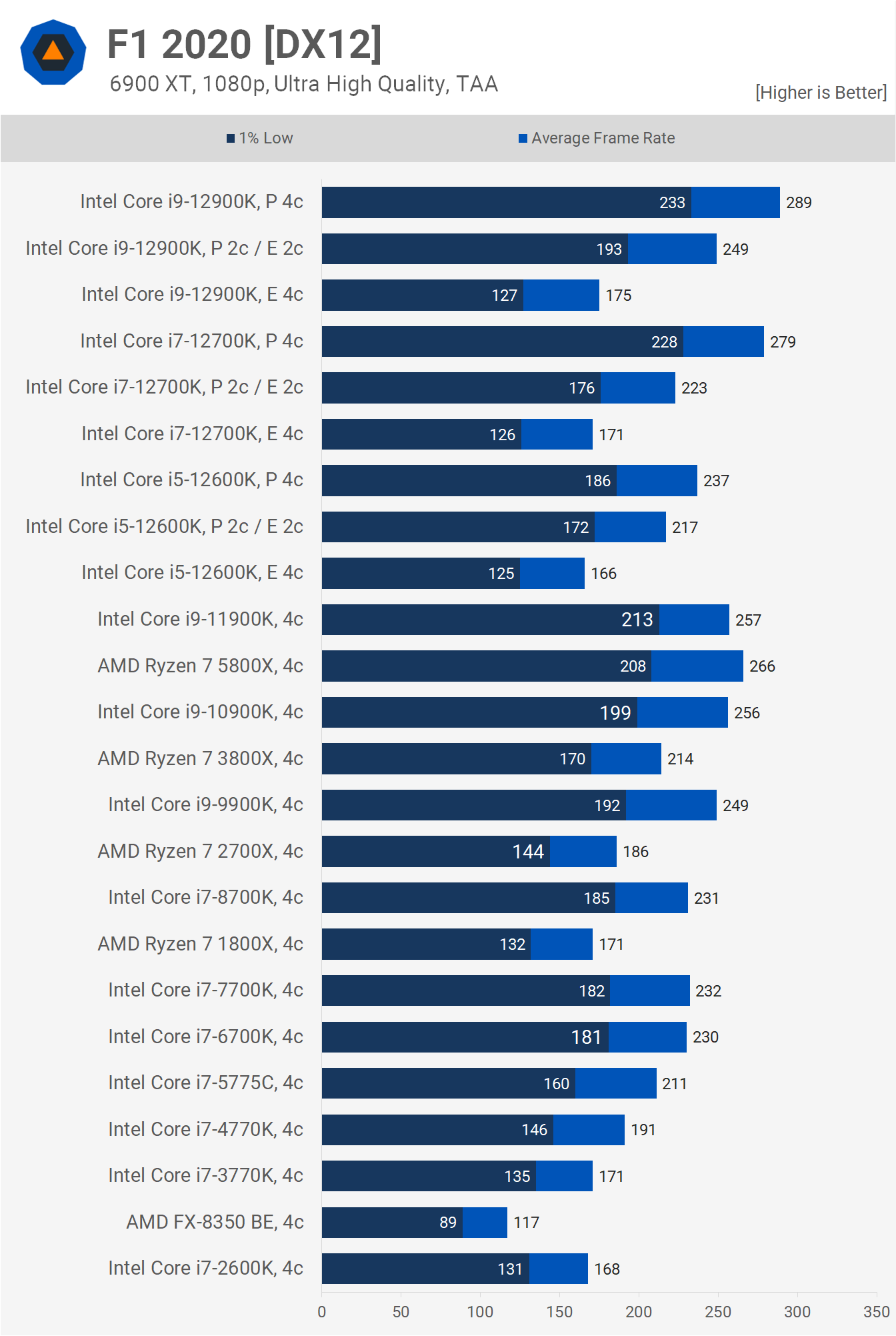
Moving on to F1 2022, nosotros come across that the Due east-cores are nowhere nearly every bit bad every bit what we saw in Battlefield V. We're looking at a 65% operation increase with the Due east-cores when looking at the 12900K and a 43% increase with the 12600K. The 12600K does appear to be choked by its smaller twenty MB L3 cache given the 12700K was 18% faster when comparison P-core operation, while the 12900K was simply 4% faster than the 12700K.
Compared to Zen 3, Alder Lake is slower when limited to a 20 MB L3 enshroud, then up to x% faster with 25 MB and 12% faster with 30 MB. As for the East-core only configuration, Alder Lake is comparable to Ivy Bridge in F1 2022 and a long way backside Skylake, the 7700K for example was 33% faster than the 12900K's Due east-core configuration.
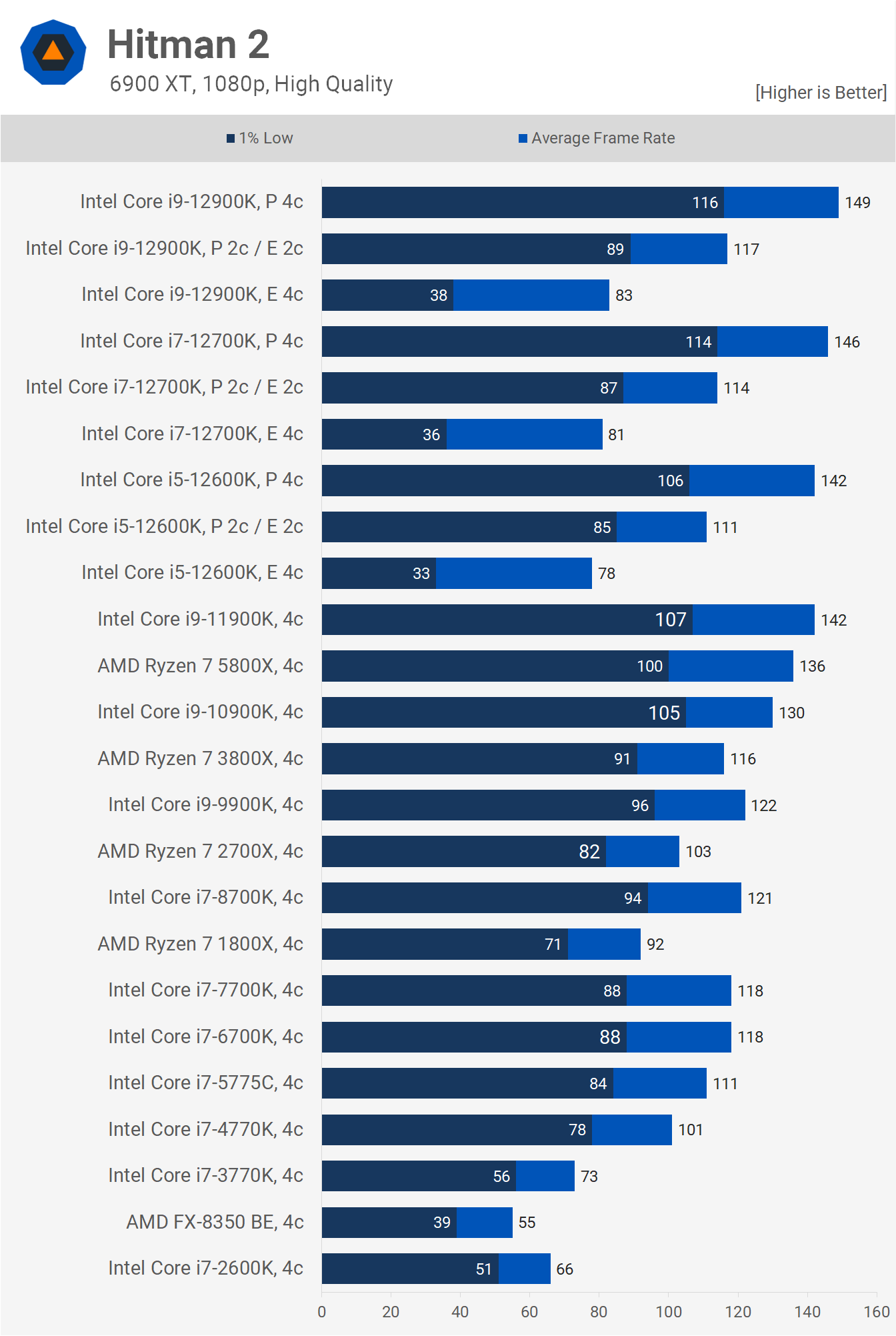
The NPC heavy Hitman 2 test crushes the Due east-cores. This is like to what was seen when testing with Battlefield V. Performance across all 3 twelfth-gen parts is similar and that means nosotros're looking at a 41% functioning improvement with 2 P-cores and 2 E-cores compared to just using the E-cores. Actually, if we expect at the ane% low functioning, it's closer to a 134% jump, which is crazy.
So we see when just using the P-cores, the average frame rate is improved by 27% when compared to the mixed core configuration.
So once again, if we compare the East-core only configurations to older CPU architectures, we see that functioning is nowhere nearly Skylake. The 1% low performance was as bad as what we saw with AMD'due south Bulldozer, while the average frame rate was much closer to Ivy Bridge than information technology was to Skylake.

Even in Horizon Zero Dawn, which isn't peculiarly CPU intensive, the E-cadre only configurations struggled, though it will eat up 4-cores/4-threads, especially if they're slow. If nosotros expect at ane% low functioning we see a 104% increase from 4 E-cores to 2 E-cores plus 2 P-cores, while going from the mixed core configuration to four P-cores only boosted operation by a farther 14%. We're also seeing very piddling performance difference between the various L3 cache capacities in this game.
If we compare with the older CPU architectures, we find that Alder Lakes E-cores aren't much meliorate than AMD's FX series once more. The i% low performance was nigh identical and that ways we're miles away from Skylake hither.

Cyberpunk 2077 is yet another game where the E-cores can't push 1% lows to 60 fps, not even shut. As a consequence we see a 100% performance improvement with the 12900K when comparing E-cores to the mixed cadre configuration, and so just a further 12% boost when only using the P-cores. Interestingly, the mixed cadre configuration of the 12900K is quite adept, whereas nosotros do run across a noticeable driblet off with the 12700K and 12600K.
Comparing with past CPU architectures, nosotros run across that the E-cores are much slower than even first generation Ryzen, and worlds slower than Skylake. We're looking at Sandy Bridge level of performance here.

Finally, we have Shadow of the Tomb Raider and here we see very little departure between the various Alder Lake CPUs, so the cache capacity has nearly no tangible influence here, at least for these core configurations. We had found previously with the tenth-gen series that the larger L3 cache is of greater utility when more cores are available.
When compared to older CPU architectures, the E-cores struggle with gaming on their own, with boilerplate frame charge per unit performance that's comparable to Ivy Bridge and 1% low performance that's only comparable to AMD's FX series. On the other hand, when only using the P-cores, Alder Lake is a animate being chirapsia Zen iii past 11% in this game.
Functioning Summary
That was eye opening to say the to the lowest degree. Those Due east-cores don't do well at gaming and there's a good reason why, which we'll get to in a moment. For now permit's take a look at the seven game average nosotros nerveless.
Across the 7 games tested we see that the 12900K was just iii% faster than the 12700K with merely the P-cores active, and eight% faster than the 12600K and those margins are entirely down to the difference in L3 enshroud chapters. The margins with two P-cores and two E-cores enabled are similar and the same is also true with but 4 Eastward-cores.
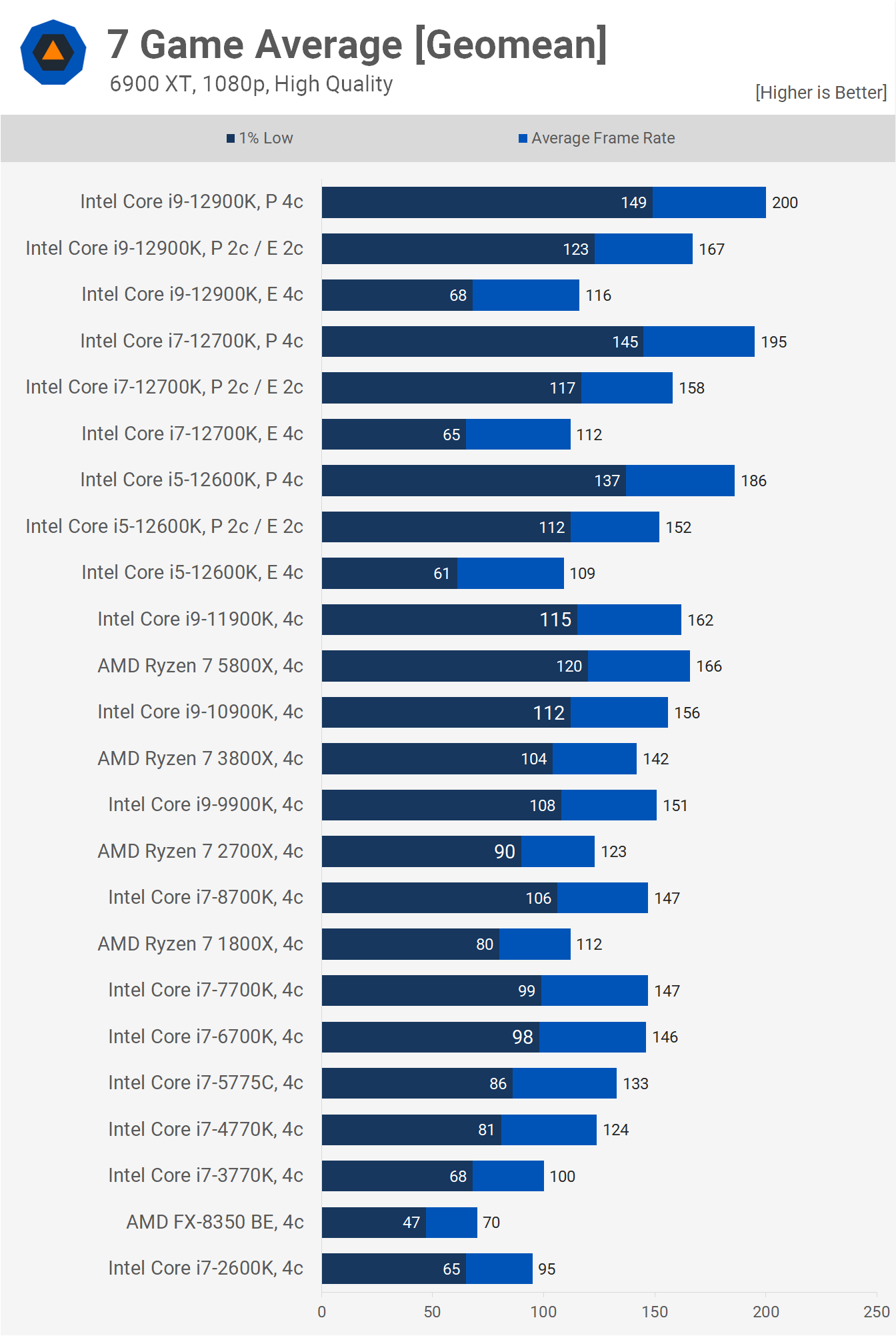
Of course, the interesting story is the deviation in performance between the various core configurations on the same CPU. So take the 12900K, for example, we saw a 44% increment in average frame charge per unit when going from 4 Due east-cores to a mix of P and Due east cores, and an 81% increase in 1% low performance. And so from the mix of P and E cores to just P-cores, the average frame rate was boosted by a further 20% and the i% low by 21%.
Obviously, you'd never run a twelfth-gen CPU with just the E-cores, which would reduce performance some ~twenty%, just permit's become deeper in the analysis in our conclusion...
What Nosotros Learned
Intel'due south 12th-gen hybrid core design is actually interesting and it does bring some obvious benefits for productivity workloads and volition no doubt prove very beneficial in the mobile infinite. Now you're probably thinking, "sure, I saw the benchmarks, I go that E-cores don't perform well for gaming on their ain, but why?"
The answer is simple, and it's the same reason why first-gen Ryzen was down on Intel for gaming when matched at the aforementioned core count. Core-to-core latency is very weak -- we're talking about a 54% increase on average.
Typically, P-cores take 37ns to communicate with one some other whereas the E-cores take 57ns and this cripples performance in games and for whatsoever other workload that relies heavily on core crosstalk.
The reason Intel's limited interconnect betwixt the Eastward-cores is to make them more efficient, both in terms of power usage and the amount of die space they require. For sequential workloads similar what we see with rendering, for example, where there's very little cadre-to-core communication, the Eastward-cores work well and this is why Intel used SPECrate2017 to make their Skylake efficiency claim.
If we look at the broader picture, the hybrid design fifty-fifty on the desktop makes sense, at least for Intel. A function like the Core i9-12900K tin can claim to business firm "sixteen total" cores with 24-threads, because technically that's what it packs, even if not all cores are equal.
On paper, the 12900K looks comparable to the Ryzen ix 5950X, and when put to the examination in applications that tin can leverage these core-heavy desktop parts, the 12900K still looks bully, as the E-cadre weakness that is core-to-cadre communication isn't emphasized past those workloads, retrieve Blender as ane such case.

Then when it comes to gaming, the 12900K still shines because not a single game requires more than 8 Alder Lakes P-cores. Even if a game can spread the load beyond xvi cores, that won't be an issue. Even in the case of the 12600K, its cores are more than powerful enough to bargain with the load. If they couldn't, the game would only be playable using a high-end CPU like the 12900K or 5950X, and that'south not going to happen this decade.
Now obviously, you'd never run a twelfth-gen CPU with but the East-cores, but in that location will be a bespeak in time when you'll have to call on the Eastward-cores for gaming and this could reduce operation by 20% or more, at least based on what we've seen here. But once more I don't expect that time will come up within the realistic lifespan of this series.

Another reason why E-cores suck for gamers is the compatibility issue with DRM, and I ran into that with this benchmark exam. Previously I'd tested all CPU architectures using Sentry Dogs Legion and Assassin'south Creed Valhalla, merely both games failed for this testing. Picket Dogs Legion worked with but E-cores, or just P-cores, but the mix crashed the game which is strange as stock the 12th-gen CPUs work just fine. Then Assassin's Creed Valhalla failed to load due to the DRM detection result with the hybrid 12th-gen architecture.
In short, the E-cores are a mistake for gaming, and if chosen upon they will reduce frame rates. And then for gamers the 12900K and 12700K are viii-core/16-thread CPUs and nothing more. The E-cores might exist able to aid with background tasks, but frankly on the desktop they'd exist amend taken care of by 2 more P-cores. There is no argument gamers can make for the being of Eastward-cores, yous'd always be much better off replacing them with two extra P-cores.
Shopping Shortcuts:
- Intel Core i7-12700KF on Amazon
- Intel Cadre i7-12700K on Amazon
- Intel Core i9-12900K on Amazon
- Intel Cadre i5-12600K on Amazon
- AMD Ryzen v 5600X on Amazon
- AMD Ryzen ix 5950X on Amazon
- AMD Ryzen 7 5800X on Amazon

Source: https://www.techspot.com/news/92444-intel-12th-gen-core-alder-lake-architectural-benchmark.html
Posted by: waldschmidthavemprought.blogspot.com
0 Response to "Intel 12th-Gen Core Alder Lake Architectural Benchmark"
Post a Comment