

How To Limit The Field Size Using Ado.net While Consuming The Restful Web Service
This commodity compares standard APIs and services to query information over the internet for analytics, integration and information management.
Jeff Leinbach, senior software engineer at Progress, and Saikrishna Teja Bobba, developer evangelist at Progress, conducted this enquiry to help you determine which standard API to consider adopting in your application or analytics/information management tool. We contrasted the differences between OData, GraphQL and ORDS, which are standard APIs and services for querying and updating data over the Internet. The focus is on achieving interoperability beyond APIs for analytics, integration and information direction.
Nosotros've been tracking these topics based on numerous discussions at industry events such as AWS re:Invent, Oracle OpenWorld, Dreamforce, API World and more. Progress also has a rich heritage in developing and contributing to data access standards, including ODBC, JDBC, ADO.Cyberspace and now OData (Residue), and was the first member to join the OData Technical Commission.
What is Residual?
Residual (representational state transfer) or RESTful web services are 1 way of providing interoperability betwixt estimator systems on the net. REST-compliant web services let requesting systems to access and manipulate textual representations of spider web resources using a uniform and predefined set of stateless operations. RESTful implementations brand employ of standards such as HTTP, URI, JSON and XML.
It'southward of import to note that REST is an architectural fashion, not a standard.
Standard APIs to Query Data over the Internet
OData
Originally adult by Microsoft in 2007, OData is an Haven standard Rest API and is established among companies such as Microsoft, SAP, CA, IBM and Salesforce. Information technology allows the cosmos and consumption of queryable and interoperable RESTful APIs in a unproblematic and standard style. OData gives you a rich set up of querying capabilities and is rapidly gaining ground for its open up source approach, as well as its exceptional scalability.
GraphQL
Developed internally at Facebook in 2012, before public release in 2015, GraphQL is a data query language deployed at companies such every bit Facebook, Shopify and Intuit. GraphQL provides a complete and understandable description of the data in your API, gives clients the power to ask for exactly what they need, makes it easier to evolve APIs over time and enables powerful developer tools.
ORDS
ORDS (Oracle Balance Information Services) is the Oracle REST service which delivers similar standardization for Oracle-axial applications. It enables developers with SQL and other database skills to build enterprise-class data access APIs to Oracle Database that today's modern, land-of-the-fine art application developers desire to use, and indeed increasingly demand to use, to build applications. Lx groups at Oracle use ORDS, including Oracle Database, Times Ten and NoSQL.
Contrasting the Standard APIs
Figure i
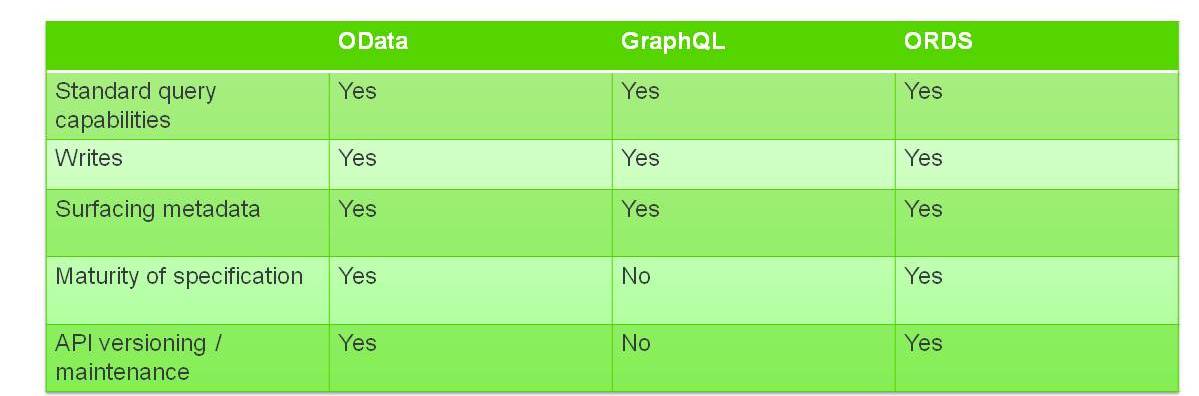
The criteria for contrasting the standard APIs in Figure 1 are based on achieving interoperability with multiple data sources. One affair to notation about this comparing is the maturity of the specification. While GraphQL is growing in popularity, questions remain around maturity for widespread adoption, all-time practices and tooling.
Nether API versioning/maintenance, y'all would think a "No" is bad, but it's actually proficient. It'due south one of the advantages of GraphQL, which I'll go into after.
Effigy 2
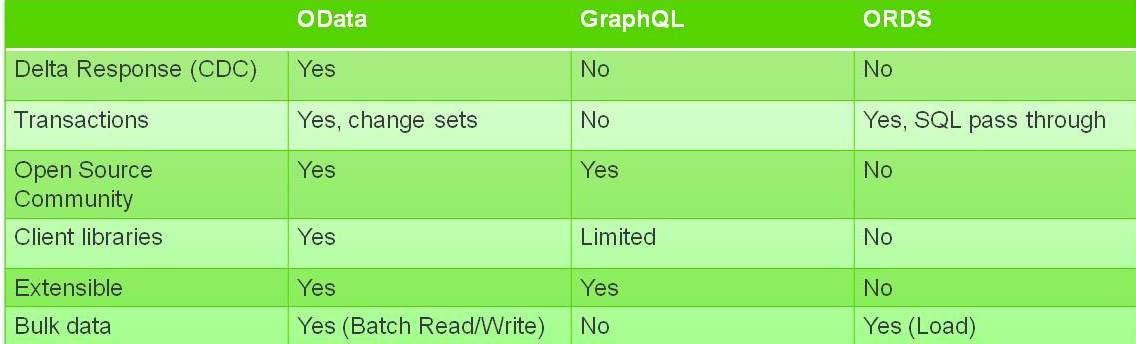
In Figure 2, nosotros completed the initial analysis on additional criteria to consider and volition expand on these areas in a future article.
Standard Query Capabilities
Figure three
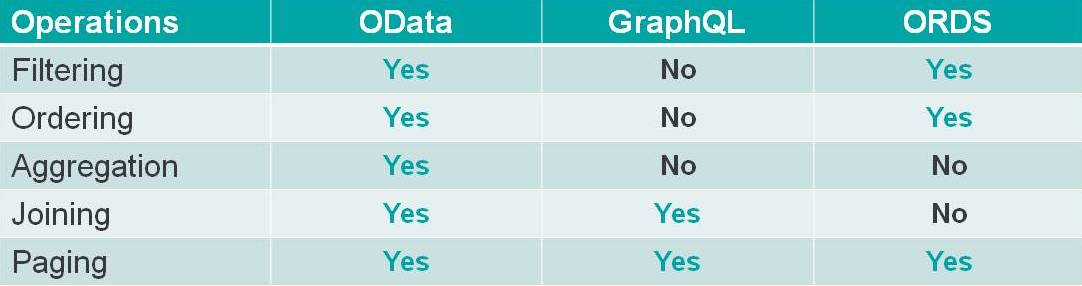
Figure 3 highlights common criteria for accessing data through open standard interfaces. OData has the full range of back up for all these query capabilities. You tin can do some of these operations with GraphQL and ORDS, simply they're not standardized or documented in a way to achieve interoperability.
GraphQL is much like REST in that it defines the manner to interact with a web service, just it doesn't tell you lot what the service does. So yous tin can practice filtering, ordering, and joins, etc. past creating functions that can call, just the application developer has to understand how those work semantically to be able to know what their behaviors are.
With ORDS, you tin can practise aggregation and joining, merely it'southward achieved through creating custom functions that you can invoke. But the application has to know what those functions do in order to sympathize how to interpret the results. There's no metadata or standard beliefs definition that can tell the application what to expect.
Surfacing Metadata
Figure 4
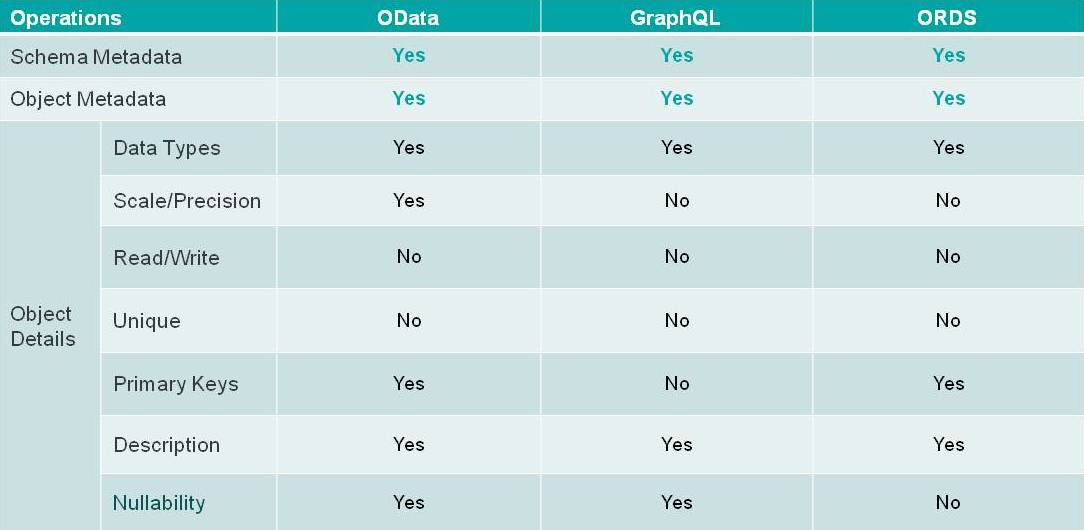
Figure 4 compares surfacing metadata, which is core to analytics and data management applications that need to programmatically reverse-engineer schemas in an interoperable way.
Each of these APIs are advancing to solve this, all the same GraphQL and ORDS don't tell you scale and precision of data, whereas OData does. GraphQL also doesn't tell you about main keys and ORDS doesn't tell yous well-nigh nullability. This information is important for an application to exist able to know what it can and can't exercise with each detail field.
API Versioning and Maintenance
I major headache is handling updates to applications when the API changes, while maintaining older versions besides. The biggest problem leading to this headache with REST APIs is that all of the fields are returned when you query an endpoint. API developers take no window into whether or not clients are relying on information in specific fields. Client developers must process all of the fields returned even if they do not demand the information.
GraphQL has addressed the trouble of API versioning and maintenance past forcing clients to specify exactly which fields they require. API developers can proactively accomplish out to known consumers of fields to migrate off of deprecated fields. The response includes information about which fields are deprecated.
OData provides like functionality by providing a select list to limit the number of fields returned to those needed past an application. This reduces response size and processing in an application. However, information technology does not provide a machinery to betoken that fields are deprecated.
OData is more flexible in that queries can be easily written to render all fields. And OData is adding schema versioning to the specification to bargain with this problem.
Examples
To visually illustrate the differences in working with these APIs, the following 2 lawmaking examples show how to do an "Order By" in GraphQL and OData.
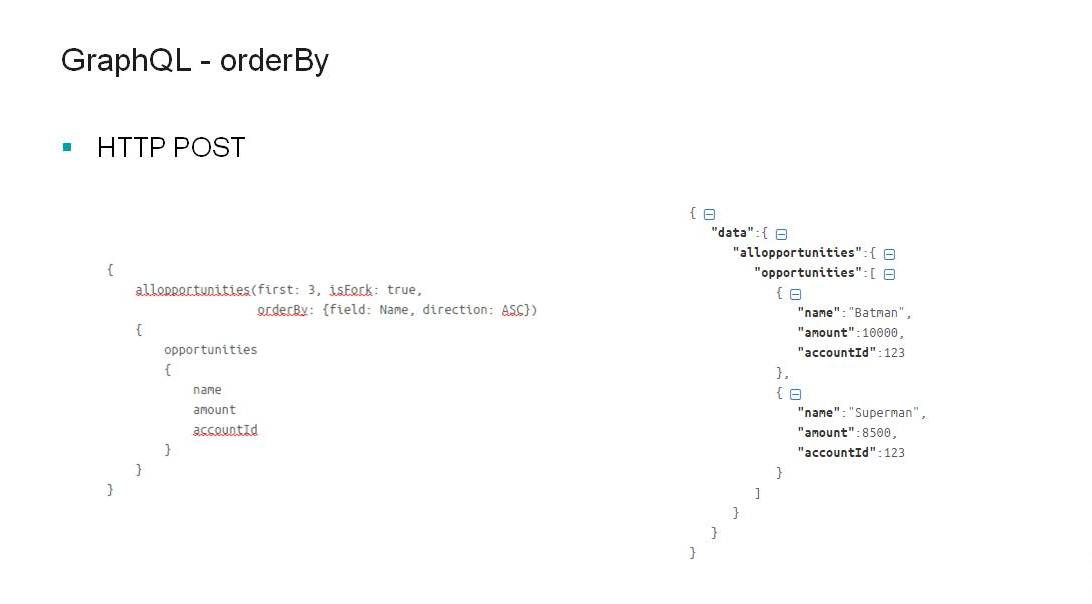
In the GraphQL example of an All Opportunities part call, information technology's somewhat obvious by the proper noun what information technology does. However, there's nothing in GraphQL that tells you what yous can laissez passer in for these arguments and how the values specified as arguments causes the part to behave. And this behavior tin be different on an implementation past implementation basis.
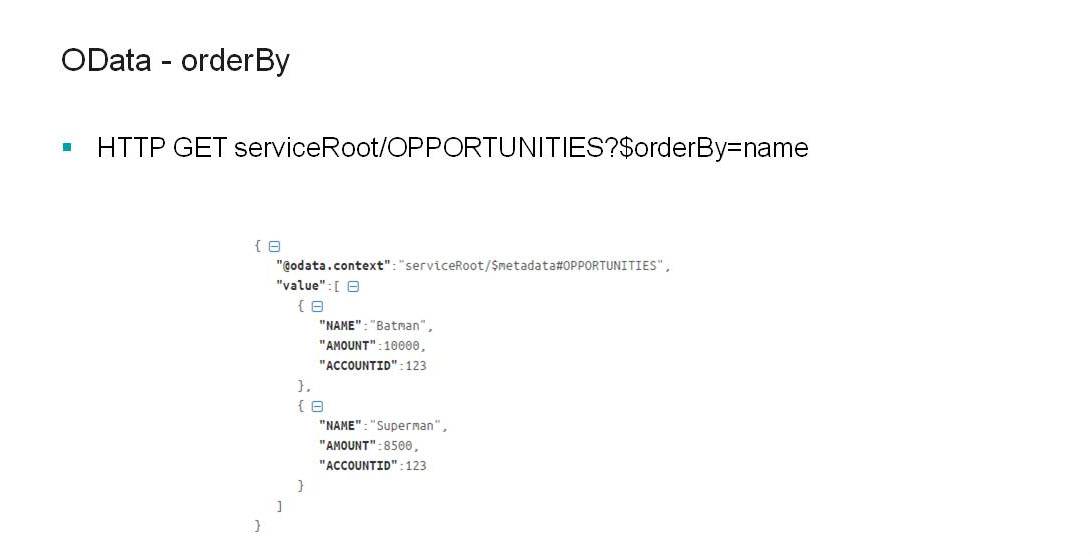
By contrast, OData tells you exactly how it's going to behave when you use the orderBy query parameter because its behavior is divers as part of the specification.
Recommendations
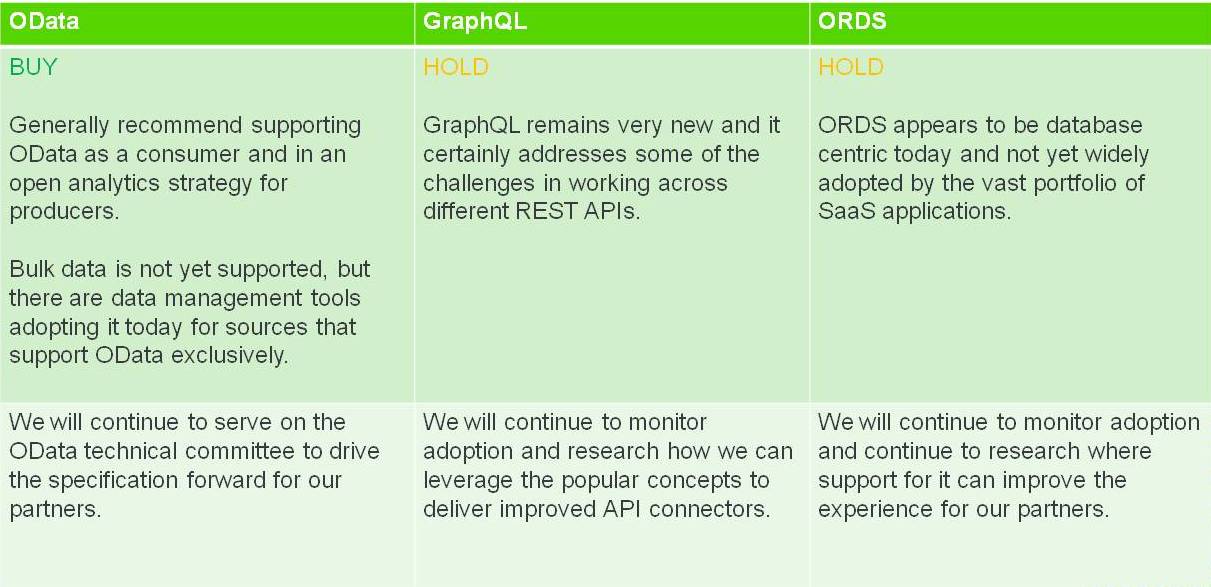
GraphQL is almost like a programming language, which makes it very flexible. It's powerful, but using it means your application is tightly coupled to how that particular GraphQL service is implemented. There's no way to generically describe how it works.
GraphQL tin besides be a bit awkward for people who are used to dealing with web services because in order to query information, you don't do a Get operation, which is how you would become results from a normal Rest web service. You exercise a POST, defining exactly which fields and functions that you desire included in the response.
So while GraphQL gives you the ability to decide from the metadata what fields and functions are available, y'all still don't know what they hateful semantically.
Removing Barriers to Entry
This article is primarily focused on the API consumers, merely GraphQL has a much lower bulwark to entry to develop an API. If you're doing a quick projection, GraphQL is probably the way to get. Only you all the same take the issue of your application being tightly coupled to your implementation.
OData is really powerful, but there'due south a lot of heavy lifting that goes with it because you accept to attach to all the behaviors of the standard. There'due south a minimum level of behaviors that y'all must have to be OData compliant. That creates a larger barrier to entry for service developers.
However, you tin leverage our hybrid technology to produce a standard REST API (OData). Nosotros do all the heavy lifting with OData, so y'all don't have to worry about adhering to the standard. Nosotros've reduced the bulwark to entry for you.
Also, there are a lot of OData clients that can help you become upward and running with the OData service quickly and hands. There'southward a laundry list of applications that are already OData-capable, too as OData client libraries that can help you if you're developing a new awarding.

How To Limit The Field Size Using Ado.net While Consuming The Restful Web Service,
Source: https://www.progress.com/blogs/rest-api-industry-debate-odata-vs-graphql-vs-ords
Posted by: waldschmidthavemprought.blogspot.com
0 Response to "How To Limit The Field Size Using Ado.net While Consuming The Restful Web Service"
Post a Comment